
The Workspace
The workspace is where you actually get work done in Codeg. It puts four things on one screen — the agent's conversation, your project's files, its git changes, and a terminal — so the whole loop of prompting, reviewing, and committing happens in one place, with no tab-switching between an editor, a diff tool, and a shell.
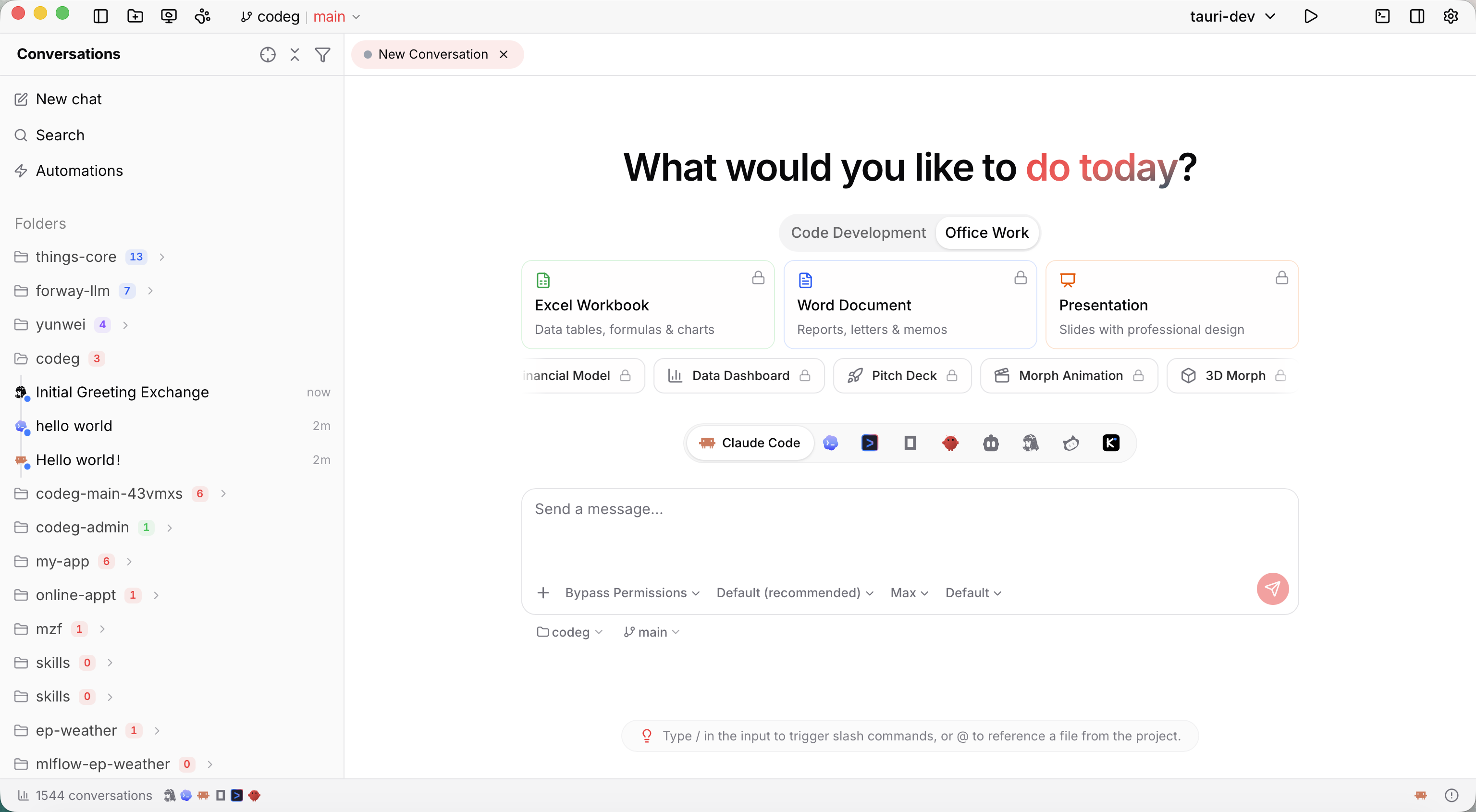
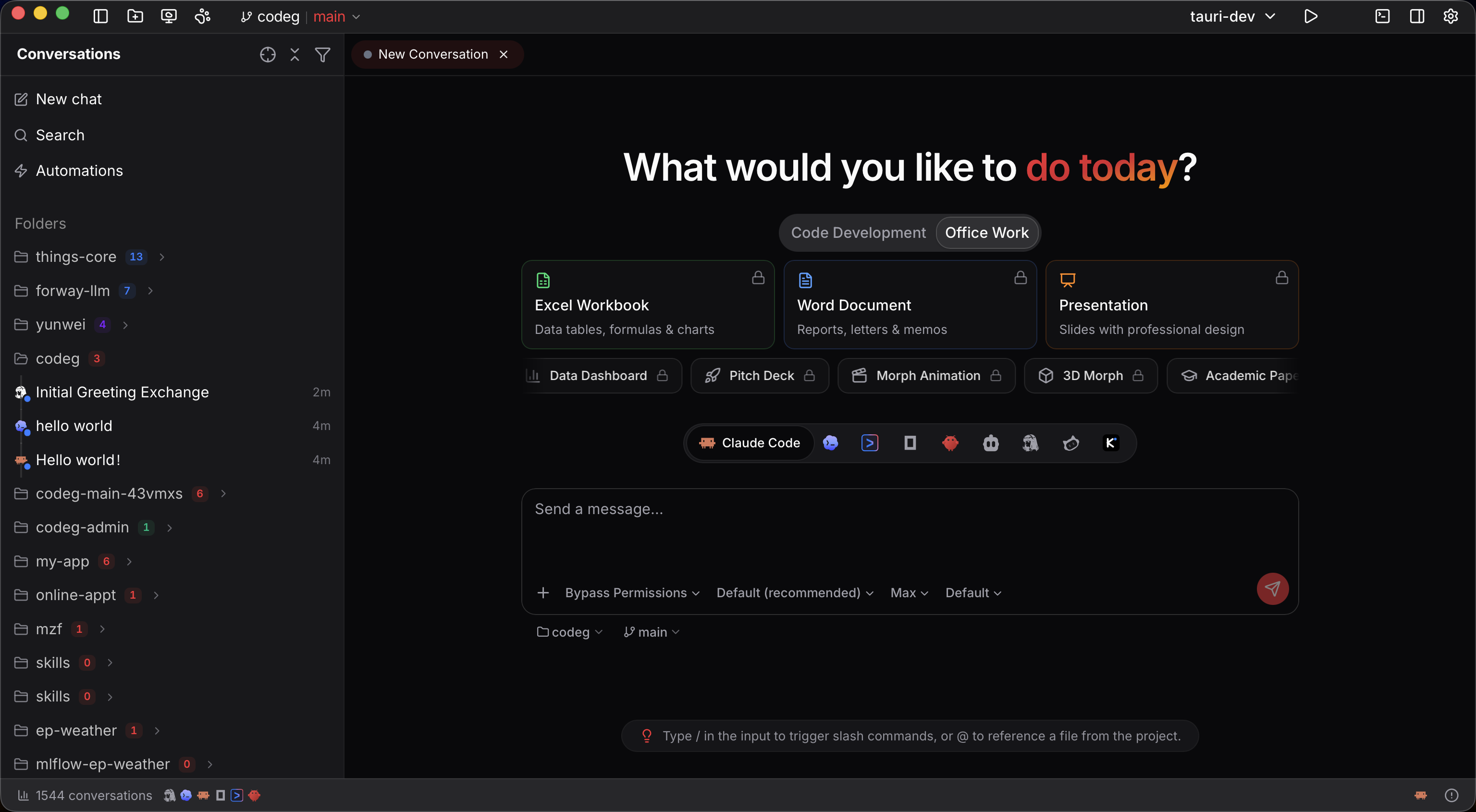
The layout
The desktop workspace is four columns side by side, each with its own header strip and divided by draggable hairlines that run from the top edge to the bottom:
- Conversations (far left). Every session across every folder you've opened — your history, and where you start new ones. They're grouped by project, each with a live status dot: In Progress, Review, Completed. The strip on top holds new chat, the tag filter, collapse-all, and view options, and beneath it sit the navigation rows: automations, To-dos, the Repository panel, and Infinite Canvas. Automations and To-dos each carry their own badge — a failed run for one, a count of tasks waiting on you for the other — so a queue that needs attention says so from wherever you are.
- Conversation (center-left). The agent's transcript, with the composer docked at the bottom. Its tabs sit on top, and a slim detail header below shows the folder breadcrumb and the conversation's title, followed by its tags.
- Files (center-right). The editor, diffs, and live previews for the files you open — right next to the conversation, so you can watch changes land as the agent makes them. It has its own tab strip and a file-path detail header.
- Aux panel (far right). A tabbed panel — Session Details · Files · Changes · Commits — holding session info, the project tree, your working-tree changes, and commit history. When the panel is narrow, the four tabs fold into a single dropdown.
The terminal opens beneath the two center columns, and a status bar along the bottom shows your conversation count, update notices, the command launcher, the codeg-mcp companion's state, and, at its right end, Alerts — the warnings and errors your sessions raised, kept for you to find again. Once you've switched it on, Computer use has an icon there too. Attached to a remote workspace, its name shows as well. Click the conversation count and it opens Token Usage — the full report of what your agents have spent, by day, folder, agent and model.
The status bar's leading edge — the window's bottom-left corner — holds Quick actions, a menu of everything that's otherwise reachable only through something that can disappear. Three groups:
| Group | What's in it |
|---|---|
| Workspace | Open folder, clone a repository, Project Boot, and remote workspaces |
| Navigation | Automations, To-dos, Repository panel, Infinite Canvas — with the same badges their sidebar rows carry |
| More | The desktop pet |
There was a Sessions group until 0.30.0. Its two rows acted on a single folder, which is exactly what a launcher in the status bar doesn't have — and both already live in the folder's own context menu and on the Folders header, so the group was removed rather than left to act on a guess.
The point isn't new capability — every entry has a home elsewhere. It's that the status bar never unmounts, so with the sidebar collapsed this is still a way in. Remote workspaces and the pet are desktop-only. Search is deliberately absent, because its own home doesn't disappear either — see below.
When a newer Codeg is out, the status bar says so itself rather than waiting to be found in Settings: a New v… badge appears, and clicking it opens a popover with the version, the full What's new release notes, and the buttons to act on it — the same Download → Install → Restart sequence as the settings panel, plus Later to wave it off. Dismissing a release quiets it in every open window, and leaves a plain grey icon behind so you can still get back to it; the next release lights the badge up again. → Settings → System
There's no full-width title bar — instead, the window chrome lives in two corner clusters that stay put as panels open and close: top-left toggles the sidebar and opens Search, top-right holds Terminal, Auxiliary Panel, and Settings. Search moved up here in 0.27 for exactly the reason quick actions exists: it used to be a row inside the sidebar, which unmounts when you collapse it, leaving ⌘K as the only way in. The chrome never unmounts, and the button is tooltipped with your live ⌘K binding. Since 0.32.3 ⌘K opens it with the cursor already in the search box, and the cursor stays there as you switch between conversations and files or pick an agent filter. (Mobile gets the same button in its title bar, where there's no shortcut at all.) The remote-workspace picker it displaced moved to the sidebar list's right-click menu, in a group of its own — every row above it acts on this machine; that one leaves for another host. Every panel resizes by dragging, and the side panels and terminal collapse away when you want room — ⌘B (conversations), ⌘E (aux panel), ⌘J (terminal). On a phone or a narrow browser window, the side panels become slide-in sheets.
To-dos, automations, the Repository panel and Token Usage take over that whole area, so while one of them is open the top-right cluster swaps its terminal and panel toggles — which would have nothing to act on — for a back arrow to your conversations. It's the way out when the sidebar is collapsed and there's no conversation on screen to click, and it changes nothing else: whatever tab you were on comes back exactly as you left it. A page that has controls of its own puts them in those freed slots: To-dos parks its view toggle and settings button there, the Repository panel its refresh and settings.
Panels slide in beside your work
Since 0.28 every sliding panel — the mobile sidebar, the aux panel, the terminal, the settings navigation, a skill's details, a task's details, a repository item's details — is an inset drawer rather than a dialog: it sits slightly in from the window edge with an edge of its own, and nothing behind it is dimmed or frozen. The page underneath stays live, which is the point — these are panels you consult while working, not modals you dismiss to get back to what you were doing. Escape, the close button, and a swipe still close one; the four mobile navigation drawers additionally close when you tap the strip of page they leave showing, because that's how you put a panel away on a phone.
Session viewers stack. A delegated sub-agent's transcript, a to-do's session, a Grok child run — all three nest into each other, since a sub-agent's transcript carries its own delegation cards with their own view session. They used to be centred dialogs with no stacking relationship, so opening the second simply buried the first. Now each opens inside the one that spawned it, all at the same width so nothing juts out underneath.
Two consequences you'd otherwise notice as bugs are gone with it: a viewer no longer closes when the card that opened it scrolls out of view, and one left open behind a full-page route or a backgrounded tab no longer paints over whatever replaced it — it's hidden and restored, so switching back finds it where you left it.
Folders and the sidebar
The left sidebar is your home base: every folder you've opened — a project directory — with its conversations grouped beneath it. Open a project folder to add one (⌘O). Right-click a folder's header (or click its ⋯) for everything you can do with it:
- Set default agent. Choose the agent a folder should use, and every new conversation you start there opens with it preselected. Pick No default (use global) to fall back to your global choice. It sets the agent only — model and mode still come from that agent once it connects.
- Change color. Give a folder an accent color so its section stands out when you're juggling several projects. The color tints the folder and its conversations in the sidebar; it doesn't carry into the tabs.
- Set alias. Give the folder a friendlier display name without touching anything on disk — it shows as alias [ folder ] in the sidebar and the conversation header. Leave the field empty to clear it and fall back to the plain name.
- Import local sessions. Open the import window with this project's past sessions preselected, to pull your agents' own history into the workspace — Codeg's conversation aggregation in action. → Conversation Aggregation covers what it sweeps and how it matches.
- Manage conversations. Bulk-select conversations to change their status or delete them. It opens from a folder, but it isn't locked to one: a search row runs the full width, and four filters sit beneath it, coarse to fine — folder, branch, agent, status — so you can sweep the whole workspace from wherever you opened it. Branches fold by shared prefix,
task/49andtask/50under onetask/with a count, and every row shows the branch its conversation was started on. - Linked folders. Bring other directories into this workspace as subdirectories, so one agent can work across all of them. → Work across several folders
- Manage tags… Create, edit, reorder and delete the tags this folder offers its conversations, along with the global ones. → Tag conversations
- Open in. Reveal the folder in Finder / Explorer / your file manager, drop into a terminal there, or — since 0.29.0 — open it in VS Code (desktop only). The VS Code entry is on directories and individual files too, not just the folder header.
- Remove from workspace. Take the folder out of Codeg — its tabs and terminals close, but nothing on disk is touched.
The folder's real name is always its on-disk directory name — that never changes — but Set alias gives it a friendlier label, and color and grouping help you tell projects apart at a glance.
Import local sessions isn't only on the folder menu. Right-click the empty space around the list for the same entry, and on a workspace with nothing in it yet the button sits right there on the empty state — next to Open folder and Project boot — since importing what you already have is usually the fastest way to make a fresh Codeg feel populated. That same empty-space menu is where the remote-workspace picker lives, in a group of its own below the local entries.
Right-clicking a conversation row offers Add to session, which drops it into the composer as a mention badge — the same badge the @ panel and the file tree produce. It lands at your cursor, and clicking it twice doesn't add it twice. It's the shortest route to "look at what happened in that session" without going through @ and typing the name. The same menu holds a Tags submenu for tagging the conversation.
The number beside a folder counts what's running in it right now — sessions actively working, worktrees included — and disappears when nothing is. It's a live workload indicator, not a total, so a glance down the sidebar tells you where your agents actually are. The expand/collapse chevron only appears on hover; the folder icon already says whether it's open.
Rest the pointer on a conversation row and a card floats out beside it with what the row itself has no space for: more of the title (up to three lines — the point is to reveal it, not to unfold an essay), the agent and the model where one is recorded, the folder — alias-aware, and badged when it's a worktree — its absolute path, the branch, and every tag it carries. If the session was re-parented out of a worktree that's since been removed, it names the original path too. There's deliberately no status on it: the row you're pointing at already badges the two states worth flagging. It costs no request; everything on it is already in memory. Before 0.29.0 the only way to get any of this was the Session Details dialog, which didn't carry the folder or its path at all — and with several worktrees of one repo open, two rows genuinely read identically.
Group your folders
A workspace with a dozen repositories in it is a long flat list. Folder groups are named, optionally coloured bands that hold folders — and they and your loose folders share one order, so the two interleave rather than groups being herded to one end.
Drag a folder onto a group's heading to put it in; drag it to the trailing zone to take it out; drag the group itself to move the whole band. While you're dragging a folder every group opens up, collapsed ones included, so nothing is unreachable. Move to group in a folder's context menu is the same thing without the pointer.
A group heading carries a running-session badge summed across everything inside it, so a collapsed group still tells you whether one of its projects has an agent working. Members indent exactly the way worktree children do, rails and conversations shifting together, because it's the same machinery underneath.
Three sections, in the order you want
The sidebar has three top-level sections:
- Folders — your projects, conversations nested under each.
- Chat — folderless conversations, the ones you started in Chat mode.
- Recent — one flat list of the conversations you can currently reach, folder-bound and chat alike, in whichever order Sort by is set to. Nothing is nested and nothing is grouped; it's the answer to "what was I just doing?" without expanding anything. It follows the same view options as the rest of the sidebar — a closed folder's conversations, a completed one while Show completed is off, and anything already in Pinned stay out of it. It shows 15 rows at a time with a Show more footer that reveals another page per click, while the section's own count badge reports the full total. Since 0.28.2 that footer also folds it back: once you've expanded past the first page, a reset appears on the same row, so a list you opened up to find one thing doesn't stay long for the rest of the session, pushing the sections below it off screen. It's offered only when more than a page is actually showing. Its header carries a new-conversation button, like Chat's, and since 0.32.3 a ⋯ that narrows the list to All, Chat or Folders — only folderless chats, or only conversations that belong to a folder. The choice is remembered on this device, and while the list is narrowed the button stays in view, so a filtered list never passes for a short one.
All three can be reordered from the view-options menu — one row per section with move-up and move-down controls (or Alt+Arrow on the focused row) — and Recent can be switched off entirely if you'd rather not have it.
Tidy the list — view options
Four buttons at the top of the sidebar keep a long history manageable. The first, a funnel, is Filter by tags, which narrows the list to the conversations carrying the tags you pick — see Tag conversations. Locate Active Conversation jumps to the session you're in, expanding whatever it's hidden behind. Expand/collapse all is its own button beside it, because it acts on the list rather than storing a preference — and it folds everything, the flat Chat, Recent and Pinned headers included, not just the folder groups inside them. Collapsed bottoms out at four header rows with nothing under them; expanding again restores the folders underneath exactly as they were, since section collapse and per-folder collapse are remembered separately.
The last is an eye rather than a second funnel — nothing in its menu narrows the list down to matches — and it opens View options, in four labelled groups:
- Conversation list (submenu) — Show completed conversations, off by default, so finished work stays out of the way and the list is what's still live; Show worktree folders, on by default; and Show Recent group, on by default.
- Navigation items (submenu) — see below.
- Sort by — Created time (the default) or Updated time.
- Section order — the reorder list described above.
The two inventories sit behind hover-opened submenus so that Sort by and Section order — the two people come back for — aren't at the bottom of a fifteen-row menu. The other two stay inline: a pair of radios and a ranked list read wrong behind another hop, and the order rows need the menu's full width. Flipping a toggle dismisses neither the submenu nor the menu, so changing two settings costs one visit.
About Show worktree folders: with it on, each worktree sits under its repo as its own group, with its own count and color. Its header reads the same alias [ name ] pair a project header does — task/49 [ codeg-task-49 ], the branch checked out there in front and the directory it lives in behind — so several worktrees of one repo are tellable apart at a glance. Since 0.30.0 the repository's own row is labelled the same way — main [ root ], lined up with its worktree siblings — instead of a bare "root" that said nothing about which branch it was on. Existing ones are labeled at startup, and a name you set yourself is never overwritten. Switch it off to merge them into the parent folder as a single list.
Choose which navigation rows you see
The Navigation items submenu switches the sidebar's four full-page rows on and off individually: Automations, To-dos, the Repository panel, and Infinite Canvas. If you don't use the forge integration, that row doesn't have to sit there.
Hiding one costs you nothing permanent — every route stays reachable from the status bar's quick actions, which is why it's safe to hide them at all. The setting is per device, and a row you've never touched is shown, so a route added in a future release arrives visible rather than silently off.
Tag conversations
Since 0.34.0 a conversation can carry tags — each a name and a colour — shown right after its title, and the sidebar can be filtered down to the conversations that have them. A tag is one of two kinds:
- Global — offered on every conversation, chat mode included.
- A folder's own — offered only on that folder's conversations, its worktrees' included. A Chat-mode conversation has no folder, so it gets global tags only.
Names are unique within each set — the global one, or one folder's — regardless of case, so a global bug and one folder's own bug can both exist, but not Bug beside bug in the same set.
To tag a conversation, use either of two places:
- The conversation header. The tags sit right after the title — or a tag icon, Add tags, when there are none — and clicking them opens a picker. Search it, and click a tag to put it on or take it off; the picker stays open, so tagging three times is one visit. Type a name that doesn't exist yet and it offers to create one: Create global tag "…", and, for a tag of the folder's own, Create "…" in followed by the folder's name — which chat mode doesn't offer. A created tag goes straight onto the conversation, coloured with the first of the nine strong presets that no tag beside it — a global one, or one of the folder's own — is using; once all nine are in use, they repeat.
- The sidebar. Right-click a conversation for a Tags submenu. Ticking a tag there doesn't close the menu either, and New tag… opens the full form, where Available in chooses between Every conversation and the folder only.
A tag from a different folder that the conversation still carries is listed apart, under Other folders. It's there so you can take it off; once off, it can't be put back. Sub-agent sessions — the ones a delegation spawned — can't be tagged.
Manage tags… — at the foot of the picker, in the Tags submenu, on a folder's right-click menu and at the foot of the tag filter — opens one dialog for all of it, starting on the folder you opened it from:
- Branch tag at the top — see below.
- Global tags, then Folder tags with a folder picker beside the heading.
- Each tag can be dragged to a new place, edited and deleted. The order you drag them into is the order chips appear in everywhere — global tags first, then the folder's own. Editing changes the name and colour, never the kind. Deleting asks first, because the tag comes off every conversation that has it and there's no undo.
- A new tag takes a name of up to 64 characters and a colour — eighteen presets in a strong and a soft row, or Custom color for any other. Added from the dialog, its kind is the section you added it in.
Where tags show. A sidebar row has room for two chips after the title, then a +N whose tooltip names the rest; a long title gives way first, but always keeps a few characters. The conversation header shows up to three — one on a narrow screen — and the card that floats out when you rest the pointer on a row shows them all. One stored colour serves both themes: a solid chip in light mode, a tint with brighter text in dark. Tagging isn't activity, so it doesn't move a conversation when the list is sorted by Updated time. Tags don't appear in search, on the canvas, in tab titles or in Session Details.
Filter by tags. The funnel at the start of the sidebar's header row picks tags to filter by, each with a count of the conversations carrying it. Match decides how several combine — Any, the default, for conversations with at least one of them, or All for those with every one. While a filter is on, the funnel is highlighted with a count, and a strip above the list shows the chosen tags, each removable, with Clear filter beside them. It narrows every section — Pinned, Folders, Chat and Recent — and takes out any folder, worktree group or folder group left with nothing to show; Show completed conversations still hides finished work in Folders, Chat and Recent — Pinned keeps it either way, as it always has — and a folder's running count is left alone. The filter is remembered on this device, while the tags themselves live in Codeg's database.
The branch tag puts the git branch a conversation started on — the same one Manage conversations lists, not the branch checked out now — as a chip in front of its tags, in a colour you choose. It's off by default: tick Show under Branch tag in the dialog. It counts toward each surface's chip limit and is never folded into +N. Conversations outside git, in chat mode, or started on a detached HEAD have no branch to show, and sub-agent sessions show none.
Tags and the branch tag setting are stored in Codeg's database, not in the window, so every window shows the same ones and keeps up as they change, a browser session gets the whole feature, and a backup carries them. A forked conversation keeps the original's tags; an imported one arrives untagged.
Work across several folders
A workspace doesn't have to be one directory. Since 0.23.1 you can link other folders in as subdirectories of it — a sibling service, a shared library, the docs repo — and the agent reads and edits across all of them from the one conversation. The file tree shows them, workspace search covers them, and @-mentions reach into them.
It takes one gesture: right-click the folder in the sidebar → Linked folders, then Add folders and pick as many as you like. (Opening a brand-new folder offers the same step right after you choose the root, so you can assemble a workspace as you create it.)
What it's for
The point isn't really "more directories." It's that the root stops having to be the project and becomes the place you assemble one — for as long as the work needs it, and no longer.
- A frontend and a backend that live in separate repos. Link
apinext toweband one turn can change an endpoint and the code that calls it, with both sides of the contract in front of the agent instead of one side and a guess. - Whichever microservices this week's change actually spans. Link the two or three involved, do the work, unlink them, link a different set next week. The workspace becomes a view over your services rather than a checkout you have to maintain.
- An empty root that owns no code at all. Make a directory purely to compose things —
~/work/current-task— and link whatever the job needs into it. Nothing to tidy up afterwards, because there was never anything there. - Code beside its documentation. Link the docs repo into the code repo and a change plus the page describing it land in the same session, in the same review. (This is how these docs are kept in step with Codeg itself.)
- A library you'd rather fix at the source. Link the shared package into the app that depends on it, and the agent can fix the bug where it actually lives instead of papering over it in the caller.
- Reference you have no intention of changing. A design-system repo, an API spec, another team's service. The agent works from the real interface rather than from what it can infer about it.
- An old repo and its replacement, side by side, while you port code across — the one case where having both trees open is the entire job.
- Sample data you deliberately keep out of the repo. Link a directory of fixtures or real-world input files so the agent can run against them without any of it being committed.
How it works underneath
The links are real filesystem links on disk, and that's a deliberate choice: agent CLIs run with their working directory set to the workspace root, so a merge that existed only in Codeg's UI would be invisible to them. Because it's a real directory entry, everything else follows — ls finds it, the agent's own file tools find it, your terminal finds it.
On macOS and Linux that's a symlink. On Windows it's a symlink too where Windows allows one, but creating one needs a privilege an ordinary process only has with Developer Mode on — so Codeg falls back to a directory junction, which needs no privilege and behaves the same for the local absolute paths it links. If both fail you'll be told to turn on Developer Mode or run Codeg as administrator.
Each linked folder appears under the name of its own directory, marked in the file tree as a linked folder. If that name is already taken in the root, Codeg disambiguates to api-2 rather than overwriting anything — case-insensitively, since macOS and Windows treat API and api as the same entry.
Manage them later
Reopen Linked folders on the same menu and each link shows its current state:
| State | What happened | What to do |
|---|---|---|
| Linked | Working normally | — |
| The link is gone from this folder | Something deleted the symlink | Recreate link |
| Another entry now uses this name | A real file or folder took the name | Rename, then recreate |
| The linked folder no longer exists | The target moved or was deleted | Re-link it at its new path |
Rename changes only how it appears inside the workspace — the directory it points at keeps its own name. Remove link deletes the symlink and nothing else; the linked folder itself is never touched.
A switch on that screen — on by default — keeps links out of git status by writing the link name into the repository's .git/info/exclude. That file is local to your clone and never committed, so nobody else's checkout learns about your linking habits.
It applies when the workspace folder is a git repository, and it's best-effort: if the rule can't be written, the only consequence is a noisier git status, never a failed link. Two gaps worth knowing — a workspace that isn't a repository has nowhere to put the rule, and renaming a link doesn't carry its rule across, so the new name will show up as untracked until you exclude it yourself.
Some picks it simply refuses, telling you which: the workspace folder itself, a folder that contains the workspace, something already inside it (no link needed — it's already reachable), and something already linked.
Only the links you made are followed
Codeg confines every file operation to the workspace root, and that guard doesn't just wave symlinks through — it consults the list of links you created. So a repository you cloned that happens to ship secrets -> ~/.ssh stays exactly as unreadable as it was before you linked anything. → Privacy & Security
What a link doesn't extend
Two things still follow the workspace root only. Live file watching — edits an agent makes inside a linked folder won't refresh the tree on their own; reopen or refresh it. And the Changes and Commits panels track the root's repository, so a linked repo's own working-tree changes and history aren't shown there. Open that repo as its own folder when you want to review and commit its changes.
Start a session — the composer
Everything begins in the composer, the input at the bottom of the conversation. Choose an agent, model, and mode, point it at a working folder, type a prompt, and send.
- Agent and model. Pick from your enabled agents and the models that agent offers. (The agent picker appears when you start a new conversation.) The row fits the width it's given: as many pills as there's room for, and the rest behind a More agents button — with the selected agent never among them, so the one pill that names your choice is always on screen and always readable.
- Mode, and the agent's own options. The dropdown lists the modes the connected agent provides — a plan-first mode, an accept-edits mode, and so on. Beside it sit whatever session options that agent advertises: a picker where it offers a list of values, a toggle chip where it offers a switch (Cline's auto approve, for one). All of it comes from the agent itself, so what you see depends on which one you're running — and an option whose kind this build of Codeg doesn't understand is quietly left out rather than being allowed to break the session. Since 0.34.0 (adapter 0.86.0) Claude Code adds an Agent option once you've defined custom subagents — the
agents/*.mdfiles Claude Code reads from your user folder, the project or a plugin — and choosing one runs the conversation as that subagent from your next message on. Like the other options it's remembered for Claude Code on this device, so your next Claude Code conversation starts as that subagent too, until you pick the default entry again; a subagent that's no longer defined is skipped. - Working folder & branch. A row just below the box shows where the agent will work: a folder chip and a branch chip. The folder chip is switchable while the conversation is still a draft (its list shows folder aliases and searches them, and a pinned Chat mode row runs folderless for a quick chat); once a conversation is bound to a folder, the chip stays as a label. The branch chip is the full git menu — see Branch and run git.
- Context and connection. At the right of that same row, a small ring tracks how much of the model's context window you've used — click it for the token breakdown (input, output, cache write, cache read, total, and since 0.31.0 a cache hit rate under the total, to one decimal; a session whose agent reports no cache counters at all leaves that row out rather than claiming a confident 0.0%) — and a heart icon shows the agent's connection status: connected, connecting, error, or disconnected. That heart is a button — see below.
- The + menu. Attach files, insert a saved quick message, leave live feedback while the agent is working, run a slash command, or drop in a skill from the Experts, Office Work, or Scientific Research packs. Live feedback opens a dialog for a note to the agent that's already running — the same channel the composer's mid-turn send rides, described below. → Settings → Collaboration
- Rich input. Type @ to mention a file, agent, past session, or commit; type / for slash commands — the match is fuzzy, so
rvwfindsreview. Long messages you've sent fold up with a show more toggle so the transcript stays readable. - Both panels behave like panels. The
@list takes the composer's own width and edges and opens above it, exactly as/does, instead of a narrow box pinned to the cursor — the extra room goes to the description, which used to be cut off. It stays with the composer it belongs to, so one left open while you switch to To-dos doesn't float over the new page. And/works while the agent is still connecting: slash commands only exist once the agent is up, so typing/early used to do nothing at all; now the panel opens with a loading row and fills in when they arrive, with no need to retype. @after CJK text, and on a phone. The mention panel used to trigger only after an ASCII space — which Chinese, Japanese and Korean don't write — and refused to open mid-composition on a soft keyboard. Both are fixed, and it keeps clear of the on-screen keyboard.- Send, queue, stop. Enter sends; Shift+Enter makes a newline. While the agent is working, Send turns into a red Cancel button — and once you have typed something on a session that can take a message mid-turn, a split send appears beside it: its button is Queue message, which is what Enter has always done there, and its chevron holds the one action that doesn't wait. Either way, type ahead and your messages queue until the agent is ready for them. → Talk to an agent mid-turn
Approvals come from the agent
Codeg has no global "auto-approve everything" switch. How freely an agent acts is governed by the mode you pick plus the permission prompts it raises mid-task (below) — so control stays with the agent's own safety model.
Follow along — the conversation
As the agent works, its transcript streams in: replies as formatted Markdown (code, math, and diagrams included), its reasoning, and a live plan checklist for multi-step tasks. A plan long enough to bury the rest of the turn caps its height and offers show more / show less, the same way a long message you sent already does.
- Every reply sits under a header. It reads Working… while the agent writes and Worked for 1m 9s once the turn settles — which is where the per-turn duration lives now, rather than in the footer stats row. Clicking the header folds away the reply's intermediate work — the tool calls and reasoning it went through — and keeps the final answer on screen, which is the part you came back for. Sending your next message folds the work above it, and that's also the state a conversation opens in when you return to it. A reply with nothing to fold away is a plain label rather than a button: one that stopped on a tool call, or whose answer is a card, stays open, because folding it would leave a lone header where the substance was.
- Thinking stays folded until you open it. An agent's reasoning arrives as a collapsed row — Thinking… while it streams, Thought once it's done — and opening it is your call. Until 0.31.2 it opened itself on the first token and closed itself a second after the block ended, which shoved the reply down the viewport mid-turn and then pulled the text out from under anyone who had started reading; the timer didn't care whether you'd opened the panel by hand. One you open now stays open, and one nobody opens renders nothing at all while it streams.
- Fork from here. A finished reply offers a fork in its stats row: the new session inherits the conversation and the original is untouched, live or reopened alike. Since 0.30.2 this is the whole feature — the composer's old Fork & Send shortcut is gone, a redundant second door to the same thing that couldn't say which reply it branched from. The action appears on a connected session whose agent advertises forking, read off the handshake rather than a fixed list — so the set grows as adapters adopt it, and already reaches past the ones below. Where it forks from is the part worth knowing, and that part is a fixed list: Claude Code, Codex and DeepSeek Harness can name the individual reply, so the fork lands exactly there — DeepSeek since 0.30.2, and Claude since 0.30.4 even when the reply you picked sits on a branch an earlier fork abandoned. Everywhere else, and on any turn carrying nothing to name it by, the fork lands at the end of the conversation instead of failing. Since 0.33.0 Codeg also asks the agent to close the original session once the fork exists, wherever the agent supports closing one — so Claude Code no longer keeps a process running for every fork, and Codex lets go of the original within about a minute. The request isn't waited on, so it's a tidy-up rather than a guarantee. Open the original on Codex straight after forking and it may still say This session is open elsewhere — reload in a minute.
- When a fork isn't offered, it says why. The button greys out with a tooltip instead of vanishing: Can't fork while a turn is running, because naming a message the agent is still writing can't mean anything; and Can't fork from this reply just yet — try again in a moment for a reply Codeg streamed but hasn't finished re-reading, where forking would quietly land at the end of the conversation instead of where you pointed. You hit the second one on the half of a reply that came before a mid-turn message. It usually clears in a second or two, when the re-read names the turn — though a turn you steered right at its end can leave the reply short of the thread's tail with no name ever arriving, and there it stays greyed.
- Tool calls appear as collapsible cards tagged with status — Awaiting Approval, Running, Completed, Denied. Shell commands stream their output live — Codex's too, since 0.32.0, instead of sitting on a
[Terminal: …]placeholder until the command ends — and repeated actions fold into a single summary like "Ran 3 commands." - A search that finds nothing isn't a failure.
rgandgrepexit with 1 when nothing matches, which used to paint a command likerg --files src | rg foored and count it as an error in its group. Since 0.33.0 a single pipeline ending inrgorgrepthat exits 1 with no output reads as completed, with the exit code still on the card. Anything else — exit 2, a line of error output, a&&chain — still shows as failed. - A result with no card of its own — an MCP tool Codeg has never seen, say — renders as a collapsible tree rather than a wall of JSON: small payloads open fully, large ones show just their outline, and long strings fold to one line. Show raw JSON switches back to the plain text whenever you want it.
- What the agent touched is summarized at the end of each reply, in two groups: New files (shown by default) and Files changed (folded up, with a count and
+/−totals). Click a card to open that file in the editor, or use its View Diff button to see just what this reply did to it — and on the desktop, Show in file manager to reveal it on disk. Deleted files are listed too, marked Remove. - File names are live. A file the agent mentions — and any file you attached with
@— renders as a badge you can click to open in the file pane. Right-click it for the same actions the file tree offers: reveal it in Finder / Explorer / your file manager, Copy relative path, or Copy absolute path. (The reveal option is hidden where it couldn't work — in the browser, or a desktop window attached to a remote workspace — and the relative form is greyed out for a file outside the current folder.) Since 0.32.2 a relative link opens too —./index.html,../docs/a.md,a.ts:12,Dockerfile, resolved against the active workspace folder, and~/notes.mdagainst your home folder — in thinking blocks as well as replies, where it used to read [blocked]. A link that's still streaming in shows as plain text until it closes. - Permission prompts. When the agent needs the go-ahead — to run a command, apply an edit, follow a plan — a card docks just above the composer: "Agent requests permission to continue this turn." Its buttons are the agent's own choices (Allow, Reject, and the like). A separate card handles multiple-choice questions the agent asks you; since 0.31.0 that one collapses to its header with a click, giving the message list its space back while the question stays pending — and it re-opens itself if the agent replaces the question set or your answer comes back failed. An agent that asks for several at once — Codex does this routinely — gets a queue: one card at a time, with a +n waiting count beside it, and the next one arrives as you answer. So a batch of approvals reads as a batch rather than as a hang. A card the agent withdraws — for a Claude Code sub-agent you stopped, or a tool that was interrupted — closes by itself, rather than lingering unanswerable and holding up the ones queued behind it.
- What each option grants. Where the agent tells Codeg — Claude Code and Codex do — a panel above those buttons spells out what each choice would actually allow, and each line is tagged with how long it lasts: This run, This session, Saved to user settings, Saved to project settings, Saved to local project settings, or Saved permanently. It's the difference between waving a command through once and writing a rule into a file your teammates will inherit, said before you press anything. Since 0.30.1 Claude Code's own buttons carry it too — this session versus always in this project — so the scope is on the thing you click, not only in the panel above it.
- An empty reply says why. If a turn ends with nothing in it, the alert doesn't just tell you to check your configuration — it names which of three things happened: the agent genuinely produced no response, it produced output Codeg couldn't parse (usually an agent/protocol version mismatch), or it sent only status updates (plan, mode, usage) and no reply. The agent's own output — its error tail, scrubbed of anything that looks like a credential — sits behind a collapsed Details in the status bar's Alerts, which is the one surface with room for it.
- Context compaction. When an agent compacts its context — because it ran out of room, or because you asked it to — Codeg marks the spot: a divider drawn across the conversation, sitting between turns rather than folding into the reply above it, because a boundary is what it is and not a tool call. It reports tokens before → after where the agent supplies them, says on hover whether it was manually or automatically triggered, and is still there when you reopen the conversation. How much of that you get depends on the adapter: Claude Code from 0.75.0 supplies the whole set, live and in history alike; Codex supplies no counts, so its divider reads just Context compacted; DeepSeek reconstructs what its log happens to carry. On Claude Code a compaction also resets the context ring beside the composer to what's left, which used to go on measuring a window that no longer existed.
- The summary a compaction kept. Since 0.32.0 a Claude Code or Codex divider can carry a Summary toggle, opening what the model retained of the dropped history — streaming in while it's written. Reopened conversations show it the same way since 0.32.3, instead of the summary turning up as a message of its own or tacked onto the end of the previous reply. Two Codex compactions in one turn get a divider each.
- A compaction that fails says so. The divider turns red and reads Context compaction failed, with the reason on hover — the service's own message where Codex sends one, rather than raw JSON — and Grok's failed compactions land the same way. One that was interrupted or cancelled stops spinning instead of sitting at in progress.
- Goals.
/goalon Claude Code and Codex renders as a card carrying the objective, the status, and the tokens, budget, remaining and elapsed counters — live, and still there when you reopen the conversation later. Its controls are whatever that agent actually implements, so Codex offers Pause and Clear while Claude Code offers Clear alone. Both genuinely stop the work: they used to only take effect at the agent's next idle point, which meant a paused goal kept running and a cleared one kept continuing itself. - Delegated work. When one agent hands off to another, a Sub-agents overlay tracks the delegated sessions — the heart of Multi-Agent Collaboration.
- Each turn ends with its model and token stats — the duration having moved up to the reply's own header — and you can export a whole conversation to image, Markdown, or HTML. While a turn is running, the row above the composer adds its output speed in tokens per second beside the elapsed time and the file count — an estimate covering the text and the thinking. It shows on conversation tabs too, and in the read-only transcripts — a to-do's session, a sub-agent's — where you're watching work you didn't start.
- Turn a message into a task. Beside the copy button — on your own messages and on finished replies alike — sits a checklist icon: Create task from message. It takes that text over to To-dos, pre-filled with the project folder, for the follow-up you noticed but don't want to do now.
- Select part of a message. Highlight text anywhere in the transcript and a small toolbar pops up over the selection with three actions: Copy; Quote, which appends it to your draft as a Markdown blockquote — so replying to one paragraph of a long answer doesn't mean copying, pasting, and adding the
>yourself; and Ask. Blockquotes render with a proper quote rule now, in the composer and in the agent's own replies. The bubble follows the selection as the thread scrolls and reflows, flips below it when there's no room above, and stays inside a narrow tiled column. Read-only transcripts get Copy alone, since there's no composer to quote into. - Ask about a passage, without derailing the thread. Ask swaps the bubble's buttons for a question box; type and submit, and Codeg opens a new conversation carrying the quoted passage followed by your question. It starts on this conversation's agent and in the same split group, so the answer comes from the same agent that produced the passage rather than whichever one a blank conversation would have defaulted to — and "why this approach?" about one paragraph doesn't cost you the thread you were reading. From a folder conversation the new one opens on that folder and working directory; from a Chat-mode one it starts as a fresh folderless chat, since chat conversations don't share a folder.
- Copy an image out. Right-click a picture for Copy image — in the transcript, in the blown-up preview, and since 0.28.2 on one you've staged in the composer but not sent yet. On the desktop this used to fail outright for JPEG, WebP and GIF; all three work now.
- Mermaid diagrams get a viewer of their own. A
mermaidfence renders as a diagram with its own controls: zoom from 0.2× to 8×, drag to pan, reset view, and fullscreen. It stays sharp the whole way up, because zooming re-lays-out the drawing at its real size rather than stretching a picture of it. The palette follows your interface theme, and switching theme redraws what's already on screen. Take it with you via Copy source or download it as SVG, PNG or.mmd. A diagram that fails to render says so and offers Show source and Retry, rather than leaving a blank where a diagram should be. - A system message shows a preview. A summary an agent writes into the transcript — Pi's branch summary, Qoder's compaction summary — used to be a shut accordion you had to open to learn anything. It renders clamped instead, with a toggle only when there's more underneath. (Claude Code's and Codex's compaction summaries live in the divider's Summary now.)
- Background work gets a strip you can watch. When an agent kicks off work that outlives the turn — Claude Code's background tasks, and since 0.30.3 the long-running commands Codex pushes to the background, badged Background in the transcript — a strip pins itself above the transcript, one row per task that's running or paused: the tool it last ran, what it has cost in tokens, a Stop button, and an Output link opening the task's log in a file tab — each of those appearing once the task actually reports one, so a row can start out as little more than a name. Only unfinished tasks are listed; a task that settles leaves the strip at once, because its outcome belongs in the transcript and a permanent list of finished jobs would just grow all session. Stopping needs a live connection you own, and a stop that's declined says so — a successful one announces itself by the row disappearing, and silence would look the same as a click that did nothing. Grok's background workflows join the strip in 0.32.3, with their phase and the agent currently working and no Stop of their own; the reply Grok writes once one finishes lands in the conversation.
- Inserting a message backgrounds what's running — on Claude Code 2.1.286 and later. That version moves a running command, MCP call or sub-agent to the background when a message arrives mid-turn — Insert into current turn — instead of waiting for it or interrupting it, and Codeg badges such a command Background like any other; a question card still open is dropped when you insert, as before. An ordinary send still queues until the turn ends. Since 0.33.0 a background command's card is no longer overwritten with internal marker text when it finishes.
- Notices pop up, they don't interrupt the reply. What Claude Code and Codex announce about a session — a model fallback, a hook that blocked your prompt, a config or deprecation warning — arrives since 0.32.0 as a toast titled with the agent's name, not as a bold line written into the reply; warnings also stay in the status bar's Alerts. Since 0.32.3 that includes a Claude Code plugin that fails to load, named with Claude Code's reason, instead of the plugin silently losing its commands, skills, agents or MCP servers.
- What an agent builds in HTML shows up in the reply. Since 0.32.3 a Codex visualization — and Claude Code's, when it uses the same skill — or a Hermes preview renders as a card right where the reply references it, instead of as raw markup. Any other local
.htmlfile a reply mentions gets a Preview row under the reply once it's finished, up to four per reply, opening into the same card. A card's header carries Reload and Open file, and a tall one folds behind Show all. A complete page starts with its scripts off: Enable scripts runs them and lets that card reach the network, for that card only and only until it's gone — nothing is remembered. A Codex visualization's own fragment runs its scripts from the start, inside a sandbox that loads code and fonts only from a few public CDNs, fetches nothing else, and can't reach your files. Paths resolve against the folder the conversation ran in.
Talk to an agent mid-turn
Watching an agent go the wrong way and having no way to say so until it finishes is the oldest annoyance in this kind of tool. Since 0.30.3 any session with a delivery channel offers a way in: type into the composer while the agent is working, and the split send's chevron holds one extra action beside the ordinary Queue message.
There are two channels, and Codeg words the action differently for each because they promise genuinely different things:
- Insert into current turn ⚡ — the note goes into the work already running and the agent sees it right away. This is Claude Code alone, on adapter 0.65.0 or newer, and that floor is a policy decision rather than a version pin: Codeg checks the adapter that's actually running, not the one it would have installed.
- Send note for next check 🕐 — the note is recorded and waits. The agent picks it up the next time it checks, which is the honest description of a tool the agent has to volunteer a call to. This is any other session whose agent was handed the
check_user_feedbacktool when it launched — Codex, Grok, Gemini, OpenCode and the rest, given the companion and Live feedback switched on before the agent started. Turning the switch on mid-session can't retrofit the tool onto an agent already running. Because those agents typically only check when prompted to, adding "check my live feedback regularly" to your original message is what makes the channel reliable.
A session with neither keeps the plain Cancel-only form it always had.
Attachments come along. A draft holding an image or an @-mentioned file steers as the same block list a normal send uses, so nothing is silently stripped — and the image shows on the message inside the running turn rather than only after you reopen the conversation. On a note session the backend won't take blocks, so the whole draft, attachment included, goes to the queue instead.
Keep typing while it goes. A send into the turn takes a moment to be confirmed, and since 0.34.0 whatever you change in the composer during that moment is kept: the box is cleared only if it still holds exactly what you sent. Kept means the whole draft — a line you added stays together with the text that was already delivered, so trim that part before you send again. Before 0.34.0 the confirmation wiped the composer, edits and all.
A message you already queued can go in too. Queued messages wait as numbered rows above the composer: drag one by its handle to change the order, Edit it back into the composer, or Remove it. Since 0.30.10, while a turn is running on a session with a delivery channel, each row also carries that channel's action — ⚡ Insert into current turn, or 🕐 Send as note for next check — so a message you queued a minute ago reaches the running agent without being retyped. Two rows don't offer it: the one you're editing, whose current text is in the composer rather than the row, and, on a note session, one carrying an attachment, which still goes out whole with the next turn. Only one insert runs at a time — the other rows' buttons grey out until it settles — and since 0.34.0 two quick clicks can no longer slip two messages in at once.
Sent notes show as rows above the composer — waiting until the agent reads one, then received. On the push channel a note is also a real message: it lands in the transcript as its own turn, the agent's answer to it starts a new turn rather than running into the previous answer mid-paragraph, and once the transcript has adopted it that way its row goes, since showing both would print the same thing twice. On the note channel there's no turn to adopt — the row is the whole of it until the agent's next check picks the text up.
Two ways it can miss, both of which say so:
- The turn ended before it got in. The draft is queued instead and sent with the next turn — announced, not silently rerouted. A queued row you clicked moves to the front of the queue since 0.34.0, so it goes out first instead of waiting behind the messages queued before it.
- The agent finished without reading it. The rows survive their turn instead of vanishing, saying "The agent finished before reading your feedback", and each offers Send as message or Dismiss. Notes that were read retire with the turn — they did their job — and your next message clears the rest.
The + menu's Live feedback entry opens a dialog onto the same channel, for a note you'd rather write somewhere other than the composer. → How live feedback reaches a running agent
When a turn fails, it says what kind of failure
A turn that dies used to leave you with a generic error and a guess. Claude Code and Codex report failures by kind — a connection issue, an access issue, a limit reached, a request rejected or a service issue, falling back to a plain session issue for a kind Codeg doesn't recognize — with the agent's own message below it.
Since 0.32.2 a session's warnings and errors arrive the same way: as a notification. Each pops up once as a toast carrying the buttons that would actually help, and stays in the status bar's Alerts list, so a toast you missed isn't gone. Two kinds stay where they belong instead: an agent retrying on its own shows under the composer (below), and a failed compaction shows on its divider in the transcript. The buttons are the agent's suggestion, not Codeg's guess. Three are understood:
- Retry resends the message the failed turn was working on. (If there's nothing to resend, it says so rather than doing nothing.)
- New session starts a fresh conversation.
- Sign in opens Settings in a window of its own, on that agent's page, leaving the workspace you were in where it was. Since 0.32.3 every agent that turns a message away because you need to sign in again gets one, not just Claude Code and Codex.
Retry and New session act on the turn that just failed, so they ride on the toast alone and go quiet once you send another message; Sign in is on the Alerts entry too. A read-only viewer — a to-do transcript, a sub-agent's session — gets the notifications without the recovery buttons.
Alerts is the status bar's right-most entry: a count, red when anything in it is an error and amber when it's only warnings. Entries are newest first, each with its message, a detail line, and — where the agent printed something — a collapsed Details holding that output, its error tail scrubbed of anything that looks like a credential. Dismiss one, or clear the lot. The same message raised again replaces its entry rather than stacking, and the list keeps the latest 50, in memory only.
What stays under the composer is only what's still in progress. When the agent is retrying on its own, an amber line says so with the attempt and the countdown — retrying 3/10, next in 4.0s — and carries no buttons, because there's nothing for you to do while it works through it. Several retries at once collapse into one strip with a +N more count. Once it has recovered, what's left is a single muted Recovered line, which takes itself off after ten seconds instead of announcing a hiccup that's already over.
A crash says why. An agent whose process dies — at launch or mid-reply — is reported with its exit status, and the last lines it wrote to its error output wait behind Details, where a bare Incoming transport closed used to be all you got. A crash mid-reply also closes the connection, rather than leaving a session that looks connected but fails every message. And an agent that asks Codeg for something it doesn't handle is told so and carries on with the turn, instead of waiting forever for an answer.
Opening an old session doesn't replay any of this: a dropped image or a failed compaction from last week stays history instead of surfacing as a live alert and a desktop notification.
A refused prompt costs you the turn, not the session. Every agent Codeg drives rejects some prompt it is perfectly healthy to keep talking to — Qwen Code answers "Slash command not supported in ACP integration" to a /mcp its ACP surface doesn't implement, OpenCode wraps a provider-side rate limit the same way. Until 0.31.2 any of those unwound the whole connection: a terminal error, and a greyed-out composer until a full respawn finished. Now the agent's own message surfaces as a non-terminal error, the turn settles, and the session stays usable — the next prompt just works. Three families stay fatal, because nothing later could survive them either: the agent having no record of the session Codeg just prompted on, an answer saying its session or process is gone, and a response that never arrived at all, which means the transport died rather than the turn. A request for authentication is turn-scoped as it always was.
When the connection looks wrong
The connection heart below the composer is a button. Click it for what Codeg actually knows about that session: the agent, its real state — Responding… is told apart from a resting Connected — the working directory, the session id, and any error. When a connection attempt fails, the heart turns red — Connection error — and its tooltip and popover say why, where it used to fall back to a dimmed Disconnected.
At the bottom sits Reconnect, and it works in every state, including the stuck connecting you'd be clicking it from precisely because it's stuck. It tries to resume the session, so your history comes back with it; where the agent can't load a session — Cline among them — or the load fails, a new agent session starts on the same conversation, which keeps its transcript but not the agent's earlier context.
When a session genuinely can't be reloaded, a banner says which of the known reasons it is rather than the generic "Failed to load session, starting new" — and one of them comes with the fix. A Codex session you've run codex archive on names the exact codex unarchive <id> command with the id filled in, and one click copies it. Before 0.29.0 that case fell outside the recognized failures, so a conversation whose history was one command away from returning was silently orphaned.
Signing out of Claude while a session is open ends that turn and nothing more. Since 0.30.3 the turn stops with "Claude Code needs you to sign in again before it can run this turn" and the session stays where it is — sign in from Settings and send the message again. It used to take the whole connection down with it and leave the conversation reading as cancelled, which said nothing about the actual cause. A delegated sub-agent in the same state reports needs sign-in rather than an unrecognized failure.
Long conversations open fast
A conversation that has been going for weeks doesn't make you wait for all of it. Codeg loads the last 120 turns — nudged back to start on one of your own messages, so a window never opens mid-exchange — and pages in another 120 as you scroll up, without the view jumping under you: the position you were reading holds while the earlier turns are prepended above it. Responses from a server or a remote workspace are compressed on the wire as well.
The window is a display concern only. Exporting still takes the whole transcript, and so does anything else that reads the conversation as a document.
A session that fails to load keeps what you can see
If loading a conversation errors, the failure now docks as a small notice above the composer with Reload and New session, instead of replacing everything with a full-page error. The transcript you already had stays on screen and stays readable.
Work with files — editor, diffs, and previews
The Files tab in the right panel is your project tree, rooted at the workspace; click any file to open it in the center file pane. Drag an entry to rearrange the project or feed the agent: drop a file or folder onto another folder (or the workspace root) to move it on disk, or drop it into the composer to attach it as a file reference for your next message — the drop target decides which, with no modifier keys. The tree also takes the keyboard: ↑/↓ move, → opens a folder or steps into it, ← closes it or jumps to the parent, Home/End go to the ends, and Enter opens a file or toggles a folder. Every row carries a ⋯ button opening the same menu right-click and long-press do — a visible way in on a touch screen, where a row is also draggable and a long press can be ambiguous.
- Copy — the path, or the file. A row's context menu carries a Copy submenu: Relative path (what a prompt or a
gitcommand wants), Absolute path (what another app wants), and File — or Folder on a directory — which puts the entry itself on the system clipboard, so pasting in Finder or Explorer writes a real copy of it. New in 0.31.2, and available on file rows, folder rows and the workspace root alike. The third row is desktop-only: in the browser, and in a desktop window attached to a remote workspace, the files live on another machine and the copy would land on that machine's clipboard, so it isn't offered. - Editing. Files open in a full editor. There's no Save button — Codeg saves on ⌘/Ctrl+S, when the editor loses focus, and automatically a few seconds after you stop typing; an unsaved file shows a
*in its tab. Send a file, or just a selection, to the agent with ⌘L. - Diffs. The agent's edits open as read-only diffs — side by side (HEAD ↔ Working Tree) or as an inline unified diff, one file at a time, with change counts and prev/next navigation. Diffs are for review; you commit from the git panel (below), not by accepting individual lines.
- The smaller diff cards read side by side too. The compact previews — a diff inside a reply, the one a permission prompt shows you before you approve an edit, a to-do's changed files, and a View Diff opened as its own tab — gained an inline ⇄ side-by-side toggle in their top-right corner in 0.28.2. Inline stays the default, and the choice is remembered and shared: set it on one and every other preview follows. A file that is purely new stays single-column, having no old side to show.
- Live previews open in the same pane: Office documents (
.docx,.xlsx,.pptx) render and refresh as the agent edits them; Markdown and HTML get a Preview ⇄ Edit Source toggle (HTML runs scripts only if you opt in); images zoom and pan. → Office Documents
Merge conflicts get their own editor
Resolving a conflict opens a three-pane merge editor — Local, Result, Remote — where you can accept changes hunk by hunk. It's the one place with per-hunk controls; everywhere else, diffs stay read-only.
Session details
The aux panel opens on Session Details — an at-a-glance readout of the conversation you're in: its title and ids, the agent and model running it, status and current git branch, and live token usage (input, output, cache, and context-window totals) with timing and timestamps. Every field has a copy button; with nothing focused it just reads No active session. It's a readout, not a control panel — the same view is available from the conversation header's ⋮ menu.
Branch and run git
The branch chip below the composer is first of all a branch picker, and there's one per conversation, so tiled sessions each show their own branch. Click it and a searchable menu opens with two halves:
- Operations, at the top — the short list that acts on the branch you're on: Pull code, Fetch remote branches, Commit code…, Push…, New branch…, and New worktree…
- Your branches, below: Local branches and Remote branches, with shared prefixes (
feature/…) folded into collapsed groups and the checked-out one marked Current. Click any other branch for its actions — Switch to this branch, Merge it into the current one, Rebase onto it, Delete branch, or Update / Push it without checking it out. A branch a worktree has checked out also offers Delete worktree and Delete worktree and branch.
The long-tail operations aren't here: stash and unstash live in the aux panel's Changes tab with the rest of the working-tree actions, and Manage Remotes in its Commits tab.
One search box filters both halves at once, so typing push finds the operation and typing part of a branch name finds the branch. In Chat mode there's no chip at all; in a folder that isn't a git repository it reads No branch and offers Initialize Git repository.
→ Git & Worktrees covers the whole workflow.
Run a saved command
The status bar carries a launcher for the commands you run over and over — a dev server, a test watcher. Codeg seeds the list from your project's package.json scripts, so it usually has something the first time you look; until then it reads Add Command. Pick one from the menu and the ▶ button runs it in a terminal, turning into ■ to stop it. Manage Commands… lets you add, edit, reorder, and delete them, and your selection is remembered per folder.
Review and commit
Two right-panel tabs put version control a glance away:
- Changes lists your working-tree edits — tracked and untracked, with per-file line counts. From here you can open a file's diff, discard an edit (Rollback), or start a commit.
- Commits is your whole history, as a timeline that loads more as you scroll. Two filter pills narrow it — Branch and Author — and Codeg remembers both per project. Click a commit to expand it: the full message, the files it touched with their
+/−counts (click one for its diff), and which branches contain it. Right-click for View Diff, New branch…, Reset to Here, or Push…
The Branch pill starts on HEAD — the branch you're on, named beside it — which re-resolves on every query, so the history follows you through each checkout and keeps working even on a detached HEAD. Naming a branch pins the view to that one, and clearing the pill with its ✕ shows every branch at once; whichever you choose is kept for that folder. Before 0.32.3 the tab opened on every branch.
The Changes tab commits directly: type a message in its toolbar and press Enter for a quick commit of the tracked files, or open the full Commit window to tick exactly what you want, write a message, and choose Commit or Commit and Push. Its menu also holds pull, fetch, push, stash and unstash. Branch switching, merging and worktrees are the branch chip's job.
Parallel development with worktrees, remote accounts, and the full git workflow have their own page. → Git & Worktrees
The terminal
Press ⌘J for an integrated terminal in your working folder — a real shell, not a sandbox. Open as many as you need in tabs. It's there for the commands you'd rather run yourself: starting a dev server, inspecting output, running a one-off script alongside the agent.
Ctrl+Shift+C copies the selection, Git Bash on Windows included, and the terminal keeps focus afterwards — the plain Ctrl+C stays what it has always been, the interrupt.
In a narrow window — a phone, or anything under 768 px — a virtual key bar sits above the soft keyboard, since a touch keyboard has none of the keys a shell needs: ESC, TAB, /, -, the four arrows, HOME, END, PGUP and PGDN. CTRL and ALT are latches rather than held keys, and mutually exclusive — tap one and it lights up, then the next thing you type is wrapped and the latch releases, so Ctrl+C is two taps and works with letters from the soft keyboard as well as with the bar's own keys. The latch is spent either way: press it before something it has no encoding for and that character goes through unchanged. The bar collapses from the terminal's tab bar, and the collapsed state is remembered for that browser or app.
Tabs and multitasking
The center area is tabbed, so several sessions stay open at once:
- Conversation tabs reorder by dragging and pin with a double-click. ⌘T opens a new conversation, ⌘W closes a tab, ⌘Tab cycles between them.
- File tabs track the files, diffs, and previews you've opened in the file pane. The + at the end of that strip opens a blank browser tab — and lists the local servers running right now, so a dev server an agent started is one click away.
- Unsent drafts survive a restart. A conversation you started but never sent comes back where it was — with whatever you'd typed in the composer still in it. Each draft keeps its own text, so two of them side by side no longer overwrite each other.
Split the conversation view into groups
One tab strip isn't always enough. Right-click any conversation tab and you can split the conversation area into tab groups — the same idea as an editor's split panes, with no fixed limit on how many:
- Split Right / Split Down — divide the current group in two. The new group opens on a fresh draft, because a conversation can't be open in two groups at once.
- Split and Move Right / Split and Move Down — same split, except this tab moves into the new group.
Every group is a complete workspace of its own: its own tab strip, its own conversation header underneath, and its own new-conversation button that inherits that group's folder. Only one conversation is active at a time — the one the composer and shortcuts act on — so splitting never leaves you guessing where a keystroke landed.
Once you're split, the same right-click menu manages the layout:
- Move to Opposite Group, or Move to Group n when there are several (each listed with the conversation it's showing).
- Change Splitter Orientation — flip a side-by-side pair into a stacked one, or back.
- Unsplit dissolves the current group into its neighbour; Unsplit All collapses everything back to one.
You can also just drag a tab across — onto another group's strip, or anywhere in its pane — and a floating chip follows the cursor while a drop indicator shows where it will land. Drag the divider between two groups to change how the space is shared. Splits mix freely: split right, then split one of those halves downward, and you get a grid.
Your layout is remembered per workspace, drafts included — reopen Codeg and the split comes back, with the same conversations in the same groups.
Two small rules keep this predictable. A draft stays in the group that spawned it (it has nothing on the server to move yet), so its move items and cross-group drag are withheld — reordering it inside its own group still works. And moving a tab between groups doesn't interrupt it: the session keeps its connection and keeps streaming while it changes home.
Tile several sessions side by side
Splitting shows one conversation per group. Tile Display does the opposite — it shows all of a group's tabs at once. Right-click a conversation tab and choose it to lay that group's conversations out next to each other: not a fixed two-up split, but one pane per open tab, side by side, scrolling horizontally when they don't all fit. This is how you run a fleet of agents at once: start a task in one, a different task in another, and watch every transcript stream in parallel without switching tabs.
- Panes are your tabs. Open another conversation (⌘T or the sidebar) to add a pane; close a tab to remove one. You need at least two conversations in the group for tiling to take effect.
- Mix projects freely. Tiled panes aren't tied to one folder — put sessions from different projects side by side.
- One pane is active. The active pane — the one the composer and shortcuts act on — is outlined with a flowing gradient border. Click any other pane to focus it.
- It's per group. Tiling and splitting compose: tile one group into a wall of transcripts and leave the group beside it on a single conversation.
- Leave anytime. Right-click → Exit Tile returns that group to the single-tab view.
Tiling is a great companion to multi-agent collaboration: tile the lead session beside the sub-agent sessions it spawns and watch the whole team work.
The welcome screen
Before a session starts, the conversation pane asks "What would you like to do today?" and offers Quick Actions in three tabs — Code Development, Office Work, and Scientific Research. Each card drops a ready-made skill (and, for Office and Research, a prompt template) into the composer with one click; anything not yet enabled for your chosen agent shows a lock that links to where you turn it on. Below it sit the agent picker and a rotating tip.
The row of skill shortcuts under the quick actions stops at its ends rather than drifting on its own: an arrow at each end moves it, and each arrow is live exactly while there's somewhere left to go.
Desktop and browser
The workspace is the same whether you run the desktop app or open codeg-server in a browser. A few things differ:
- Files. The desktop app uses native file dialogs and can Open in Finder / Explorer / terminal; in the browser you upload files or pick a file on the server instead.
- Window & extras. Custom window controls and the desktop pet are desktop-only; the browser adds a login (your access token) and a reconnect prompt if the connection drops.
- Remote workspaces. A desktop app can attach to a remote server, at which point its file operations behave like the browser's — while its built-in browser opens the remote host's own addresses, since 0.32.2.
- Your windows come back. Since 0.33.0 the desktop app reopens the workspace windows you had open when you quit — the local one and each remote workspace, with the one you were using back in front. A remote workspace that can't be reached is reported in the local window instead.
- Quitting stops what Codeg started. Since 0.33.0 agents, terminals and the web service are shut down whichever way you quit — ⌘Q, the Dock, logging out, or logging off on Windows — as they always were from the tray's Quit.
- Touch screens. On a phone or tablet, switching to another conversation no longer pops the on-screen keyboard up over it; tap the composer when you want to type. With a mouse or trackpad nothing changes.
Keyboard shortcuts
| Shortcut | Action |
|---|---|
⌘/Ctrl B | Toggle the Conversations panel |
⌘/Ctrl E | Toggle the right (Session Details / Files / Changes / Commits) panel |
⌘/Ctrl J | Toggle the terminal |
⌘/Ctrl T | New conversation |
⌘/Ctrl K | Search conversations and files |
⌘/Ctrl W | Close the current tab — on macOS also with focus inside a web page or an HTML preview |
⌘/Ctrl Tab | Cycle between tabs |
Enter / Shift+Enter | Send / newline |
⌘/Ctrl L | Add the current file or selection to the chat |
⌘/Ctrl S | Save the current file |
⌃⌘Esc / Ctrl+Alt+Esc | Stop computer use — every share ends at once (desktop app, while it's on) |
These are the defaults; several can be changed.
Next steps
- Working with Agents — enable an agent and run your first session in the workspace.
- Conversation Aggregation — how past sessions from every agent land in the Conversations list.
- Git & Worktrees — the full version-control workflow, including parallel development.
- Token Usage — what the conversation counter in the status bar opens.
- Multi-Agent Collaboration — delegate parts of a task to other agents.